 There is no standard or typical truck accident settlement. The value comes from three things: what happened (who is at fault), what injuries were caused (now and into the future), and and how much is actually collectible (via insurance policy limits or corporate collectability). Recoverability is often limited by available insurance coverage — and although federal rules require many trucking companies to carry at least $750,000 in liability coverage, several companies often can share responsibility for one crash.
This guide covers what you can recover, who pays, the evidence that drives value, how fault changes the number, how to judge an early offer, how much of a settlement you actually keep, and how wrongful death settlements work. It’s based on the trucking litigation and trial experience of Passen Powell Jenkins, a Chicago trial firm, with substantial trucking accident results across Illinois and nationwide.
How much is a truck accident settlement worth?
Clients sometimes come to us asking what is their truck accident case worth. A trucking crash settlement value depends on three main factors: liability (who is responsible for the crash), damages (past and future injuries and life-altering consequences caused by the crash), and collectability of a judgment against the responsible parties (typically their limits of available insurance coverage).
In other words, the value is built on those main factors, which are different in every case:
- Damages: what the crash has cost and will keep costing, both financially (economically) and personally (non-economically).
- Liability: who is legally responsible and how strongly the evidence shows it.
- Insurance: how much coverage each responsible party has.
Severity drives the first part, and tractor-trailers are overrepresented in fatal crashes. In Illinois in 2024, tractor-trailers were involved in 3.7% of all crashes but 8.4% of fatal crashes (Illinois Department of Transportation). Of the 106 people killed in Illinois tractor-trailer crashes that year, 83 were in other vehicles. Nationally, in two-vehicle crashes between a passenger vehicle and a large truck, 96% of the occupants killed were in the passenger vehicle (IIHS, 2024).
Most of the people killed or seriously hurt are the ones outside the truck.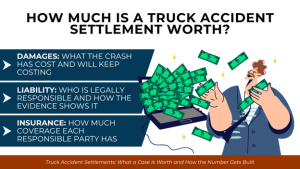
What can I be compensated for after a truck accident?
In Illinois, you are entitled to be compensated for your financial losses and for the physical and emotional harm of the injury. State law puts no cap on either. In limited cases, punitive damages are also available.
Financial losses and personal harm
Compensatory damages are meant to make up for what the crash took from you and the harm it caused. They come in two kinds:
- Economic damages: the dollar losses, such as medical expenses or lost wages. Illinois’s joint-liability statute refers specifically to “past and future medical and medically related expenses” (735 ILCS 5/2-1117).
- Non-economic damages: the physical and emotional harm that doesn’t come with a receipt — common categories of those damages include past and future pain and suffering, loss of normal life, emotional distress, and disfigurement.
Medical expenses are measured by their reasonable value. In Wills v. Foster, 229 Ill. 2d 393 (2008), the Illinois Supreme Court held that an injured person can recover the reasonable value of medical care, not only the amounts Medicare and Medicaid paid. Oftentimes, doctors in our cases will testify the the amount billed for medical treatment provided was “reasonable”, and therefore those amounts are used as evidence and ultimately recoverable.
Illinois has no statutory cap on compensatory damages in personal injury or wrongful death cases, economic or non-economic. In Lebron v. Gottlieb Memorial Hospital, 237 Ill. 2d 217 (2010), the Illinois Supreme Court noted that the state’s 1995 law P.A. 89-7 had been held void in its entirety. The court also struck down the separate damages caps for medical malpractice.
Punitive damages
The Illinois Supreme Court allows punitive damages in cases where a wrong is “committed with fraud, actual malice, deliberate violence or oppression, or when the defendant acts willfully, or with such gross negligence as to indicate a wanton disregard of the rights of others.” Still, the Court cautioned that punitive damages are not appropriate in cases alleging negligent (unreasonable) conduct only. (Slovinski v. Elliot, Ill. S. Ct. No. 107146, 2010).
Since August 11, 2023, Illinois law has allowed punitive damages “when applicable” in wrongful death cases and in survival claims (the person’s own injury claim, which continues after their death) (740 ILCS 180/1; 740 ILCS 180/2; 755 ILCS 5/27-6). Wrongful death lawsuits filed on or after that date are covered.
In wrongful death and survival claims, punitive damages are not available against the State of Illinois, a unit of local government, or an employee of either acting in an official capacity (740 ILCS 180/1, 180/2(a); 755 ILCS 5/27-6). Separately, in any lawsuit, a local public entity “is not liable to pay punitive or exemplary damages” (745 ILCS 10/2-102).

Who pays a truck accident settlement, and how much insurance do they have?
A truck accident settlement can be paid by several parties: the truck driver, the trucking motor carriers (oftentimes there are multiple), and sometimes the freight broker, the shipper, a maintenance contractor, or a manufacturer. Many trucking companies must carry at least $750,000 to $5,000,000 in liability coverage under federal rules.
The parties who may be responsible
A truck crash can involve a whole chain of businesses:
- The truck driver
- The motor carrier, the trucking company operating the truck
- The freight broker or shipper that arranged the load
- The maintenance contractor that serviced the truck
- The manufacturer of the truck or a defective part
Freight brokers are a live issue. In Montgomery v. Caribe Transport II, LLC, 608 U.S. 219 (2026), the U.S. Supreme Court unanimously held that federal law does not block claims that a broker carelessly chose a carrier. The case came out of an Illinois crash. Federal law’s safety exception keeps those claims alive. Earlier, in Sperl v. Henry, 2018 IL 123132, a broker and a motor carrier were both vicariously liable for a truck driver. Vicariously liable means legally responsible for someone else’s conduct.
How much insurance does a trucking company have to carry?
Federal law sets minimum public-liability coverage for motor carriers (49 C.F.R. § 387.9):
- $750,000 for for-hire carriers hauling ordinary non-hazardous freight across state lines in vehicles rated at 10,001 pounds or more
- $1,000,000 for carriers hauling oil and certain hazardous materials
- $5,000,000 for carriers hauling certain bulk hazardous substances, explosives, and other listed materials
These amounts are floors, not caps. Many motor carriers carry underlying coverage and multiple layers of excess coverage into the eight figures.
Not every commercial truck falls under these minimums. They apply to for-hire carriers moving property across state or national lines, and to hazmat carriers (49 C.F.R. § 387.3). A private carrier that doesn’t haul hazardous materials is outside the $750,000 tier. So are vehicles under 10,001 pounds unless they carry certain hazardous materials. Illinois adopts the federal insurance rules for in-state carriers (625 ILCS 5/18b-105(b)), but the federal limits on who must carry the $750,000 still apply. Amounts for in-state for-hire carriers are set under Illinois Commerce Commission rules.
The practical point is that the coverage in a given case has to be confirmed, not assumed. Our attorneys are extremely thorough and persistent in discovering all potentially responsible parties and all viable layers of insurance coverage before ever approaching settlement discussions. 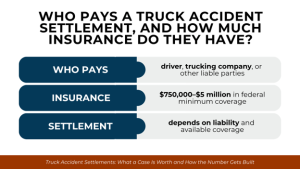
What evidence proves the trucking company was at fault?
Key evidence in a truck case comes from the trucking company’s own files, including driving-hour logs, maintenance records, and the driver’s qualification file, and from required post-crash drug and alcohol testing. Federal rules allow some of those records to be discarded in as little as six months.
Federal Motor Carrier Safety Regulations set these requirements:
- Hours-of-service logs. Unless an exception in 49 C.F.R. § 395.1 applies, a property-carrying driver may not drive without first taking 10 consecutive hours off duty. They may not drive more than 11 hours in a shift and may not drive more than 14 hours after coming on duty. Except for certain short-haul drivers, they must take a 30-minute break from driving after 8 hours of driving. They’re limited to 60 hours on duty in 7 days or 70 hours in 8 (49 C.F.R. § 395.3). With certain exceptions, carriers must record duty status on an electronic logging device (ELD) (49 C.F.R. § 395.8(a)). Federal law bars false logs and bars tampering with an ELD “so that the device does not accurately record and retain required data” (§ 395.8(e)). Carriers only have to keep these records for 6 months (§ 395.8(k)(1)).
- Maintenance records. Carriers must “systematically inspect, repair, and maintain” their vehicles and keep records of inspections and repairs. Those records must be kept “for a period of 1 year and for 6 months after the motor vehicle leaves the motor carrier’s control” (49 C.F.R. § 396.3).
- The driver qualification file. This includes the driver’s employment application, driving records, road test certificate, and medical examiner’s certificate. It must be kept for as long as the driver is employed plus three years. Some items, though, can be removed three years after they were created (49 C.F.R. § 391.51).
- The accident register. Carriers must keep an accident register for 3 years after the date of each accident (49 C.F.R. § 390.15).
- Post-crash drug and alcohol testing. When a crash involves a death, each surviving driver must be tested (49 C.F.R. § 382.303).
Illinois adopts these federal rules for in-state carriers too (625 ILCS 5/18b-105(b)). There are exceptions. Agricultural operations at any time of the year, and grain hauling within 200 air miles, are exempt from the hours-of-service rules. Some in-state drivers working within 150 air miles are exempt from the duty-status recording rules.
The trucking company holds these records. The shortest retention clock runs from when the carrier receives each record, so some of those clocks may already be running.
Will my settlement be reduced if I was partly at fault?
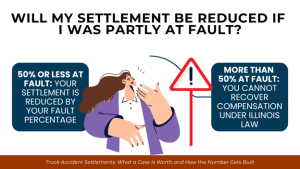
Yes. Under Illinois law, your recovery is reduced by your share of the fault. You’re barred from recovering only if you were more than 50% at fault.
Illinois uses modified comparative fault: your share of fault is weighed against the total. The statute says an injured person “shall be barred from recovering damages if the trier of fact finds that the contributory fault on the part of the plaintiff is more than 50% of the proximate cause of the injury or damage for which recovery is sought” (735 ILCS 5/2-1116). Below that line, damages are “diminished in the proportion to the amount of fault attributable to the plaintiff.”
In plain terms:
- 20% at fault: you recover 80% of your damages.
- Exactly 50% at fault: you still recover, reduced by half. People often call this the “51% bar,” but the statute’s actual test is “more than 50%.”
- More than 50% at fault: you recover nothing.
If the case goes to trial, the jury is instructed in writing that the defendant “shall be found not liable if the jury finds that the contributory fault of the plaintiff is more than 50%” (735 ILCS 5/2-1107.1).
Should I accept the trucking company’s first settlement offer?
Short answer: No. Certainly not before you know three things: the full extent of your medical needs, every party who may be responsible, and every insurance policy that applies. A signed release can end the claim against whoever you settle with.
Before taking any offer seriously, ask:
- Do I know what my future care will cost? Future medical expenses are recoverable. An offer made while you’re still treating may not account for them.
- Have all the responsible parties been identified? A broker, a maintenance company, or a manufacturer may share responsibility.
- Has the carrier’s evidence been obtained? Logs can be discarded after 6 months.
- What will I owe out of it? Medical liens come out of a settlement (see below).
- What does the release actually release? Under Illinois law, a release given in good faith to one party doesn’t release the others “unless its terms so provide” (740 ILCS 100/2(c)). The wording of the release decides whether you’re giving up claims against everyone. Your claim against the remaining parties is also reduced by the amount stated in the release or the amount actually paid, “whichever is greater.”
It also helps to know the pressure on the other side of the table. The insurance industry’s own figures show commercial auto liability severity rose 93.5% between 2015 and 2024 (Insurance Information Institute, an insurer-funded group). The National Association of Insurance Commissioners reports that the commercial auto line generated over $10.0 billion in underwriting losses over two years, driven by the liability line. It also reports a 71.4% pure direct loss ratio for commercial auto liability in the first half of 2025. These figures suggest commercial auto insurers are under financial pressure to keep payouts down.
How much of my truck accident settlement will I actually keep?
You keep the settlement minus attorney’s fees, out-of-pocket expenses, and any liens or rights of reimbursement, which are legal claims against your recovery for repayment of medical care. Illinois caps most health-care provider liens at 40% of the recovery in total.
Under the Health Care Services Lien Act (770 ILCS 23/10):
- All health-care liens combined “shall not exceed 40%” of the settlement or verdict.
- No single category of provider (all physicians, for example, or all hospitals) can receive more than one-third.
- If the liens reach 40%, all health care professionals’ liens combined are limited to 20%, and all health care providers’ liens (such as hospitals) to another 20%. Unused amounts are reallocated within the 40% total. Attorney liens are then limited to 30%. That attorney limit falls away if any party appeals.
- Only the lienholder can waive or reduce these limits.
The Act does not cover Medicare, Medicaid, self-funded ERISA health plans, or workers’ compensation. Those claims for repayment follow their own rules.
It is critical to have an experienced trucking accident lawyer who is knowledgeable and skilled in resolving all health care liens and insurance company rights of reimbursement to protect the client’s interests after settlement of one of these claims.
How does a wrongful death truck accident settlement work?
A wrongful death claim is brought by the personal representative of the estate on behalf of the surviving spouse and next of kin. When it settles, the circuit court divides the money based on how dependent each family member was on the person who died. In practice if the family is in agreement as to how the money should be divided, the court usually agrees with that allocation.
The Wrongful Death Act makes any person “or company or corporation” that would have been liable had the person survived liable for the death (740 ILCS 180/1). The recovery is “for the exclusive benefit of the surviving spouse and next of kin.” A jury may award “fair and just compensation with reference to the pecuniary injuries resulting from such death, including damages for grief, sorrow, and mental suffering, and punitive damages when applicable” (740 ILCS 180/2(a)).
An agreed settlement is distributed “by the circuit court” to each family member in proportion to their percentage of dependency (§ 2(b)). The judge holds a hearing to decide each person’s degree of dependency and calculates each share, taking into account any reduction for fault (§ 2(i)).
Separately, the person’s own claim for their injuries before death, the survival claim, continues under 755 ILCS 5/27-6 and can include damages for pain and suffering, loss of normal life, emotional distress, and punitive damages when applicable.
When should I talk to a truck accident lawyer?
It’s really important to contact an experienced personal injury lawyer, especially one with truck accident experience, as soon as possible after the crash. They can be helpful in preserving and gathering relevant evidence, retaining necessary experts, and providing important advice about how to proceed. At the very least, this should occur before signing any release or accepting any offer.
Bare minimum steps to take:
- Don’t sign a release or accept an offer until you understand your long-term medical needs and exactly who the release covers.
- Keep everything: medical bills and records, letters and settlement offers from any insurer, and the crash report.
- Get the evidence secured early. Make sure preservation of evidence letters are sent ASAP. Hours-of-service records can be discarded 6 months after the carrier receives them.
We Are Experienced Truck Accident Attorneys
Passen Powell Jenkins is a Chicago-based trial firm that handles catastrophic injury and wrongful death cases, including a substantial number of truck cases. It takes a limited number of cases so each client gets full attention. Relevant background and results from our named partners:
- Matthew Passen recovered just under $24.6 million, the full available insurance coverage, for a family whose teenage son suffered a severe traumatic brain injury when a distracted tractor-trailer driver rear-ended them on I-88. The trucking company filed for bankruptcy, and this settlement was only possible after we were able to lift the trucking companies’ bankruptcy stay.
- Matthew Jenkins successfully resolved many seven- and eight-figure trucking cases before co-founding a claims management technology and analytics company for catastrophic commercial vehicle claims and became President, CEO and COO of a commercial transportation insurance company. He returned to join PPJ’s trial practice and brings his deep knowledge of the trucking insurance industry to help maximize the results for our seriously injured clients or families of those killed in truck wrecks. He also speaks nationally on a variety of trucking accident topics as a member of the Academy of Truck Accident Attorneys.
- Jordan Powell recently secured an $11.9 million trucking settlement for a 40-year-old with a traumatic brain injury — the largest personal injury settlement ever recorded in that conservative Illinois county.
Passen Powell Jenkins works on a contingency fee with free consultations. It serves clients throughout Illinois and handles trucking cases nationwide. To talk about a truck accident case, contact the firm at passenpowell.com or call us at 312-527-4500.
Past results do not guarantee a similar outcome. Every case is different.